Vitrine de la RDC
 DEMOCRATIC REPUBLIC
OF CONGO MINISTRY
OF HIGHER EDUCATION AND
UNIVERSITY
DEMOCRATIC REPUBLIC
OF CONGO MINISTRY
OF HIGHER EDUCATION AND
UNIVERSITY
HIGHER INSTITUTE OF APPLIED TECHNIQUES

KINDU MANIEMA
NETWORKS, MOBILE TELEPHONY AND BIOLOGICAL EFFECTS
BY
TUKA BIABA SAMUEL Garcia
Assistant and researcher at ISTA KINDU Province of Maniema of
Congo, Dept. of electricity: tukasamuel23@gmail.com
Year 2020-2021
Summary:
The development of mobile telephony was a new area of study, as it resulted for the first time in the exposure of populations to ultra-high frequency electromagnetic fields emitted by nearby sources (telephone antenna, relay antenna or BTS, ...). Electromagnetic radiation has given rise to multiple concerns regarding its potential effects on the health of the user of this technology, in the short and long term, over the past 15 years, when the cell phone appeared.
The possible effects of the electromagnetic waves used are of concern to researchers. And faced with the abundance of these strange radiations coming from our means of communication, a question arises concerning their effects on human health and in particular on biological tissues.
The electromagnetic interaction between mobile phone waves and biological tissues falls within the objectives of this research work, based on the effect of the presence of human tissues on the electromagnetic parameters of mobile phone networks and the effect of GSM waves on human health. Indeed, a biological system irradiated by an electromagnetic wave is crossed by induced currents of significant density.
The total electric field E in the biological system is unknown. An evaluation of the power distribution induced by an electromagnetic wave in a spherical model of the brain allows to say that, the quantity of energy received by the brain from the electromagnetic waves is very high compared to that which emerges from it by radiation, and that almost all of the energy received is transformed into heat.
The use of high frequencies, of the order of tens of gigahertz and more can cause non-thermal effects damaging to the health of an exposed biological system.
 1 M.
Plante, ''Cellulaires et santé'', l’électromagnétisme et la
santé, le Médecin
1 M.
Plante, ''Cellulaires et santé'', l’électromagnétisme et la
santé, le Médecin
du Québec, volume 45, numéro 4, avril 2010.
This depends on the frequency, intensity of these waves and the duration of exposure to them.
In this work we will mainly approach, the mathematical and numerical analysis using the method of moments as a basic tool allowing to model the total electric field and the distribution of electromagnetic power in the studied biological system, to estimate the effect of the exposure to non-ionizing radiation. And we tried to set precise limits that would protect man against the undesirable effects of this radiation. Then, the developed models will be simulated using Matlab software for their validity.
Keywords: Networks, mobile telephony, Method of moments, biological system, impact on health.
1. Introduction
Since its inception, mobile phone networks and communications networks have evolved so much that they have become an essential communication tool. When the threads disappear, the waves take over, but this communication increasingly brings into play health effects. The RF field is the association of an electric field and a magnetic field which vary in time and propagate in space, these fields are likely to move electric charges, and are characterized by several physical properties including main are: frequency,
wavelength, intensity and power [1][2].
So all living matter contains electric charges (ions,
molecules…) and insulating materials; it is therefore a weakly conductive medium (called a dielectric). Depending on the position of the cell phone relative to the human head, the tissue (layers of the head) is subjected to an RF field, part of the field is reflected, and the other enters the body. The radiation produced
2 II.4] P. Demaret, '' Effets biologiques des rayonnements électromagnétiques'', INRS, 7e Conférence Internationale, Malte, 8-12 octobre 2012.
by this interaction needs to be quantified, as it can cause biological effects. The field that penetrates inside the tissues can be calculated using electromagnetic models, and the dose of energy absorbed by transformation into heat is quantified by the power absorbed per unit mass of exposed biological material. It is defined by the
specific absorption rate (SAR)[3][4]. So the vast
majority of radiation in our environment is of artificial
origin. Faced with the profusion of these strange radiations coming from our means of communication,
we asked ourselves [5 ] and it therefore seems necessary to ask yourself some questions to know [6]
ü What were their effects on living things and in particular the human head?
ü Do the waves emitted by our daily mobile phones present a health risk?
ü What pathologies can occur depending on the frequency or intensity of "aggressive" waves or depending on the duration of exposure to them?
When a biological entity is subjected to electromagnetic fields, an interaction occurs with the electrical charges of the tissue or cell. The result of the interaction may produce a biological effect. This is a problem that concerns us all and to which a jump in consciousness is necessary insofar as most of us use cell phones, live at a more or less distant distance from relay antennas, from lines to high voltage or remain stuck for several hours a day in front of a computer screen or TV.
Although the short-term effects of such exposure are fairly well known, the scientific community is not unanimous on the long-term health effects.
Several epidemiological and experimental studies have been carried out on this subject and most of them have led to the establishment of biological effects that may
threaten medium or long term health. [7]. Theoretical
studies have also made it possible to estimate doses of
electromagnetic energy absorbed by animals and
humans[8].
 3 L. Hardell, C. Sage, “Biological effects from electromagnetic field exposure and public exposure standards”, Biomedicine & Pharmacotherapy 62 (2008), Elsevier Masson 31
December 2007, pp.
104 - 109.
3 L. Hardell, C. Sage, “Biological effects from electromagnetic field exposure and public exposure standards”, Biomedicine & Pharmacotherapy 62 (2008), Elsevier Masson 31
December 2007, pp.
104 - 109.
4C. Sage, D. O. Carpenter “Public health implications of wireless technologies”, Pathophysiology (2009), Elsevier, January 2009, N°. of pages
14.
5 MOUMEN CHERIF : Op.cit. Page 1
6 T. B. Carlos KONLACK* et Roger TCHUIDJAN : Analyse de
l’impact des ondes électromagnétiques sur l’homme, Département des
It should be noted that this book deals with similar subjects while highlighting different aspects of the same general theme. We will consider for our application the particular case of a human brain subjected to electromagnetic radiation from the cell phone. And an emphasis is placed on estimating the effect of exposure to non-ionizing radiation.
Our work is aimed at supplementing and strengthening the veracity of some of the results already obtained. To do this, this work mainly addresses:
 Mathematical and numerical analysis using the
method of moments as a basic tool to model the total electric field and the distribution of
electromagnetic power in the studied biological
system, to estimate the effect
of
exposure to non-
ionizing radiation.
Mathematical and numerical analysis using the
method of moments as a basic tool to model the total electric field and the distribution of
electromagnetic power in the studied biological
system, to estimate the effect
of
exposure to non-
ionizing radiation.
 Assessment of the SAR rate which is the basic
limit quantity appearing in most regulations and
standards relating
to exposure to electromagnetic
radiation.
Assessment of the SAR rate which is the basic
limit quantity appearing in most regulations and
standards relating
to exposure to electromagnetic
radiation.
This rate is a measure
of the rate at which
electromagnetic energy is absorbed per unit mass
of
tissue.
Set precise limits that would protect man against the undesirable effects of this radiation.
The models developed will be simulated using Matlab software for their validity.
2. Methodological Protocol
To carry out this study and better understand the distribution of the total electric field and electromagnetic power at various points in a biological system (human brain) and to predict possible health consequences there, we will proceed according to two approaches:
ü mathematical analysis
ü digital analysis
These approaches are based on the laws of electromagnetism and use the method of moments as processing tools. This is a digital study comprising:
ü Presentation of the integral equation
ü Processing and solving the integral equation.
Génies Électrique et des Télécommunications, ENSP B.P. 8390, Université de
Yaoundé I, Cameroun
7 De RIDDER et VANHOORNE « Exposition aux champs magnétiques
50Hz et cancer: Un aperçu de la littérature récente, », Archives of public
Health, Vol. 53, n°1-4 (1995) 35-52.
8OM P. GANDHI « State of Knowledge for electromagnetic absorbed dose in man and animals », Proceeding of IEEE, Vol. 68, N°1, January (1980).
ü The change of form from the integral equation to the matrix equation.
ü Calculations of the components of the matrix
ü And finally the solution of the matrix equation
3. Study hypothesis
There is some need for approximation in our study. Indeed, biological systems are quite complex due to their geometric shape and the inhomogeneity of their internal constitution. This is how we formulate the hysteresis according to which for our study a biological system with one dielectric characterized by three main parameters which are:
ü The permittivity ε: it is linked to the capacity of the
medium to be influenced by electric charges
ü Magnetic permeability µ: It reflects the influence of the magnetic field on the environment
ü Conductivity σ: It reflects the capacity of the
medium to convey electric charges.
4. Mobile phone network: operation and technical aspects:
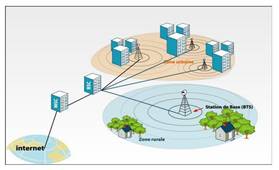
Mobile phones are radio transceivers that communicate with cell towers. The frequencies currently used are in the 900 or 1800MHz (GSM) and 2100MHz (UMTS) range without forgetting the 2400MHz range corresponding to WiFi and Bluetooth for access to WiFi terminals or the use of accessories communicating with mobile phones. Bluetooth. The structure of the mobile network is cellular. The capacity of Base Stations (relay antennas) being limited, the size of the cells is larger in the countryside (several km) than
in the city (a few hundred meters) [9][10].
5. Main interactions between electromagnetic fields and living matter
Several interactions can take place with frequent exposure to an electromagnetic field.
This leads to short-term effects, direct (biological responses) or indirect. According to WHO, the current state of scientific knowledge does not demonstrate the long-term danger of exposure to low-intensity electromagnetic fields.
The interactions between electromagnetic waves and the human body are complex and depend on a large number of factors related to the characteristics of the wave and the biological tissue encountered. An electromagnetic field comprises two components: (an electric field and a magnetic field) thus, the nature of the interactions is different for each of these components.
The importance of these interactions depends on:
ü Intensity
ü Frequency
ü The orientation of the electromagnetic field to which the tissue is exposed
ü The geometry of the fabric and its electromagnetic
characteristics:
* Magnetic permeability (μ)
* Dielectric permittivity (ε)
* Conductivity (σ)
*The coupling between the field and the body, that is to say: tissues, organs
6. Mathematical analysis and modeling
To be realistic in our research, we will highlight the
physical laws in particular[11] :

 Maxwell-Faraday: ∇ × �⃗ = − ��⃗
��
Maxwell-Ampère: ∇ × �⃗ = �� +
 ��⃗⃗
��⃗⃗
��
(1)
(2)
Figure 1: the architecture of the mobile telephone network
9 Electrosmog-info, ''Téléphones
Mobiles et Champs
Electromagnétiques'', V1, novembre 2010.
10 Ph. Piolé, ''Comment caractériser une antenne'', Fiche savoir
0123, 30 juillet 2004.
Maxwell-Gauss : ∇. �⃗ = � (3)
La loi d’Ohm : 𝑗 = ���⃗ (4)
B⃗⃗ = μ0 ∗ H⃗ (5)
D⃗⃗ = ε0 ∗ E⃗ (6)
In order to explain the actions and effects of
electromagnetic waves on the human body.
11 Joseph Antoine BASSESUKA SANDOKA NZAO : Notes des cours des applications de l’énergie électriques, destinées aux étudiants finalistes du département d’électricité premier cycle de l’ISTA/KINSHASA RD Congo
The incident field �� induces in the biological system
Si G⃗
� (r, r′ )�� represents the electric field produced
fields �� which in turn induce currents of density �𝜏 by
virtue of equation (4) such that we can write:
by the elementary source then the combination of equations (10), (12) and (17) gives rise to:
�� ��
� � ′ 2 ′ ′
 𝑗⃗⃗𝜏 = [��(�, �,
�) + ���[�(�, �, �) − �0 ]]�⃗ � (�, �,
�) (7)
𝑗⃗⃗𝜏 = [��(�, �,
�) + ���[�(�, �, �) − �0 ]]�⃗ � (�, �,
�) (7)
Therefore, we have the Maxwell equations below:
× ( × G⃗ � (r, r )�� ) − 𝜗 G⃗⃗ � (r, r )�� = −�����0�(r − r ) (18)
This makes it possible to obtain the following
solution:
� �
� × �� = −𝑗⃗⃗ −
����� (8) ⃗
1 � � ⃗
 �� 𝜏
�� 𝜏
G�� (r, r′ ) = −���𝜇0 [1 +
��2 ��
( )] G (r, r′)� (19)
��
 � × �� = ����� (9)
��
Avec : ��: three-dimensional position vector:
��(�, �, �)
The combination of equations (8) and (9) leads to:
Considering the three-dimensional Green function, we can write:
G⃗⃗ � (r, r′) = G⃗ �� (r, r′ )�� + G⃗⃗ �� (r, r′ )�� + G⃗ �� (r, r′)�� (20)
G⃗⃗ � (r, r′ ) Is solution of the following differential
equation :
 � × ( � × �� ) −
��2 �� = −���𝜇 𝑗⃗⃗ (10)
� × ( � × �� ) −
��2 �� = −���𝜇 𝑗⃗⃗ (10)
� × ( �
 ��
��
× G⃗ � (r, r
′)) − ��2G⃗⃗ � (r, r′)
= ℵ⃗ �(r − r′) (21)
�� ��
0 𝜏
��
ℵ̃ = �� �� + �� �� + �� �� (22)
� × ( � × �� ) − ��2 �� = � 𝑗⃗⃗ (11)

 �� ��
�� ��
�� 𝜏
Or : ℵ̃ : represents the unit dyad and is defined
 Avec : ��2 = ��2 ��0 �0
𝜗 = ��√��0 �0
𝜗 : Phase coefficient in free space.
The solutions of equations (10) and (11) are written:
by :
Note: G⃗⃗ � (r, r′) is equal to the electric field at a point r
due to an infinitesimal source placed at r ’. From
equations (12) and (21) we can write:
�� (r) = −���μ0 ∫ G⃗ � (r, r′). J
r′ . dv′ (23)
�� = −�𝜔 [1 + 1
� ( � )] A⃗ (12)
v′ 𝜏 ( )
 ��2 �� ��
G⃗⃗ � (r, r′) : as a singularity at r = r ’, so solution (23)
diverges if the point r considered is in the volume of
 �� = 1
� A⃗ (13)
the biological system or in the source region.
��0 ��
Or : A⃗⃗ : vector potential :
A⃗ = μ0 ∫ G⃗⃗ � (r, r′ ). J (r′ ). dv′ (14)
v′ 𝜏
To solve the problem of divergence encountered in equation (23) one excludes in the field of integration a small volume surrounding the point r where one calculates the field, one will therefore add to the principal value β of the solution ( 23) a corrective
With : G⃗ � (r, r′ ): Green's functions: the electric field
′
produced by the source by a given source.
term as indicated by the following formula:
� ( )
( )
�� (r) = � ∫ G⃗ r, r′ . J r . dv′ − J��(⃗r)
(24)
G⃗⃗ � (r, r′ ) =
1
 4�|r⃗ −r⃗ ′|
� −���(r⃗ −r⃗ ) (15)
v′ 𝜏
�3�μ0
Note : Equations (10), (11), (12) show that �� and
�� depend on �𝜏
Considering that is 𝑗⃗⃗𝜏 an elementary source placed
in position r′ and oriented in the direction of * y *
such that we can write:
The total electric field in the biological system is the
sum of the incident �� and dispersive fields ��
�� = �� + �� (25)
The combination of equations (7), (24) and (25) lead
to the following tensor integral equation:
 ��(�)
��(�)
′ ⃗ ( ′) ′
� (26)
�3�ε v′ � �
�𝜏 = �(r − r′ )�� (16)
[1 + ] �� (��) − � ∫ ��(𝑟 )� (��)G r, r
0
. dv = �
The corresponding vector potential can be written:
𝐴 = μ0 G⃗⃗ � (r, r′ )�� (17)
Expression (26) represents the integral equation of electric field present in the biological system. This
total electric field �� is unknown and can be
determined by the method of moments.
The product �� (��)�� (r, r′ ) of equation (26) can be
evaluated as follows:
[�][�] = −[�� ] (33)
After evaluating the coefficients of the matrix G, we
��� (r, r′ ) ��� (r, r′ ) ��� (r, r′ )
�� (��)
can solve the matrix equation which is in the form:
�� (��)�� (r, r′ ) = [��� (r, r′ ) ��� (r, r′ ) ��� (r, r′ )] [�� (��)] (27)
�
��� (r, r′ ) ��� (r, r′ ) ��� (r, r′ )
�� (��)
[�][�] = −[� ]
The matrix of G is symmetrical. The coefficients of the
matrix are written as:
By inversion of the matrix G we obtain the solution:
[�] = −[�]−1 [�� ] (34)
′ 1 �2 ′
 G⃗ ���� (r, r ) = −���𝜇0 [��� + ��2 �� �� )] G⃗ 𝑎 (r, r ) (28)
� �
�, � = 1,2,3
If we consider that the biological system proposed in
this work comprises in ∅ identical cells of volume �� (k=1, 2… ∅) and by admitting that the cells are infinitesimal so that �� (��) and ��(��′ ) are constant,
equation (26) becomes ::
Please note: The coefficients of the matrices G and E
are evaluated using computer processing (in Matlab).
7. Propagation of E / M Energy
Through a Biological Medium Since its inception, mobile telephone networks and communications networks have evolved so much that they have
[1 + ��(�) ] �
(𝑟 ) −
become an essential communication tool. When the
 �3�ε0
�3�ε0
�� �
wires disappear, the waves take over, however this
∑3 [∑3
��(��� ). � . ∫ Ġ
̇(𝑟⃗⃗⃗� , r′). dv′] �
𝑟 =
�=1
�=1
�� ����
�� ( � )
communication increasingly involves health effects
��� (��� ) (29)
problems. The RF field is the association of an
̇ ′ electric field and a magnetic field which vary in time
If we assume that [Ġ ���� (𝑟⃗⃗⃗� , r )] is a matrix of (m × n)
elements, its coefficients are of the form:
and propagate in space, these fields are likely to move electric charges, and are characterized by several
physical properties including main are: frequency,
�� = ��(𝑟 ). �. ∫ Ġ
̇(𝑟 ̇ , ṙ′ ). dv′ . � �
[1 +
�
�����
��(��)
� � ���� �
�� ��
wavelength, intensity and power [
12][
13. ]
 �3��ε0
] (30)
So all living matter contains electric charges (ions,
molecules…) and insulating materials; it is therefore
With: �, � = 1,2 … ∅ et �, �=1, 2,3.
Consider the following column matrices
�
a weakly conductive medium (called a dielectric). Depending on the position of the cell phone relative to the human head, the tissue (layers of the head) is
��
[��� ] = [
��� (𝑟1 )
⋮
��� (𝑟∅ )
]: Et [�� ] = [
��� (𝑟1 )
⋮
�� ∅
�� (�� )
] (31)
subjected to an RF field, part of the field is reflected,
and the other enters the body. The radiation produced by this interaction needs to be quantified, as it can
cause biological effects. The field that penetrates
Des équations (26) et (29) on obtient 3∅ équations pour �� �� , �𝑡 �� aux centres de chacune ∅ des cellules. Ces 3∅ équations sous forme matricielle
donnent :
From equations (26) and (29) we obtain 3∅ equations for �� �� , ��� �� at the centers of each ∅ of the cells. These 3∅ equations in matrix form give:
inside the tissues can be calculated using electromagnetic models, and the dose of energy absorbed by transformation into heat is quantified by the power absorbed per unit mass of exposed biological material. It is defined by the specific
absorption rate (SAR)[14][15].
When a biological entity is subjected to
[��� ] [��� ] [��� ]
[�� ]
[�� ]
� �
�
electromagnetic fields, an interaction occurs with the
[[��� ] [��� ] [��� ]] [[�� ]] = − [[�� ]] (32)
electrical charges of the tissue or cell. The result of
[��� ] [��� ] [��� ]
[�� ]
[�� ]
the interaction may produce a biological effect. The
complexity of the phenomena posed is due to multiple
Equation (32) is written more simply as follows:
12 V. I. T. Ahmed and al, “Effect of mobile phone radiation on
heart rate
variability”, Computers in Biology and Medicine 38 (2008), Elsevier, March
2008, pp. 709-712.
13 N. Pellieux, ''Champs électromagnétiques'', INRS, 1er éditions
mars 2008.
factors, in particular the diversity of independent
14M. Plante, ''Cellulaires et santé'', l’électromagnétisme et la santé,
le Médecin du Québec, volume 45, numéro 4, avril 2010.
15 P. Demaret, '' Effets biologiques des rayonnements électromagnétiques'', INRS, 7e Conférence Internationale, Malte, 8-12 octobre 2012.
physical parameters: frequency, power and
modulation of electromagnetic fields [16 ][17. ]
8. Sources of exposure
Given the huge number of mobile phone users, it is important to research, understand and monitor any potential effects on public health. Communication by mobile phone is done by transmission of radio waves through a network of fixed antennas called base stations. Mobile phones are low energy radio frequency transmitters, operating at frequencies between 450 and 2700 MHz, with maximum
emission between 0.1 and 2 watts [18].
9. Mobile phones and base stations
The main sources of exposure are mobile phones and base stations, which emit RF radiation. In both cases, exposure levels generally decrease with increasing distance from the source. For mobile phones, it is mainly the side of the head that is exposed when the user holds his handset in his hand; when using hands- free, parts of the body closest to the phone are exposed. With regard to base station emissions, exposure of the population as a whole affects the whole body but normally at levels of intensity much
lower than those of handset stations[19].
10.Mechanism of interaction
EMFs cause torsional forces at the level of molecules, which can result in displacement of ions from undisturbed positions, vibrations in bound charges, as well as rotation and reorientation of dipolar molecules such as water. . These mechanisms are not able to produce visible effects resulting from exposure to low intensity EMFs, because they are covered by random thermal agitation. In addition, the reaction time of the system must be fast enough to allow it to react during the period of the interaction. These two considerations imply that a threshold (below which no observable reaction occurs) and a cut-off frequency (beyond which no reaction is observed) is
required. [20].
Usually, exposure to electromagnetic fields results in
extremely uneven deposition and distribution of
16 L. Hardell, C. Sage, “Biological effects from electromagnetic field
exposure and public exposure standards”, Biomedicine & Pharmacotherapy
62 (2008), Elsevier Masson 31 December 2007, pp. 104 - 109.
17 C. Sage, D. O. Carpenter “Public health implications of wireless technologies”,
Pathophysiology (2009), Elsevier, January 2009, N°. of pages 14.
18 R. Vignal and al, ''Effects of mobile phones and radar radiofrequencies on the eye'',
Elsevier Masson, Pathologie Biologie 57 (2009) 503-508.
energy within the body. Regarding the absorption of energy by the human body, electromagnetic fields can be divided into four categories:
1- Frequencies ranging from approximately 100
KHz to less than 20 MHz, the absorption of which decreases rapidly at trunk height, while it can remain significant in the neck and legs.
2- Frequencies ranging from approximately 20 MHz to 300 MHz, the absorption of which can be quite high throughout the body, up to higher values if partial body resonances come into play.
3- Frequencies from about 300 MHz to several GHz, at which a significant heterogeneous local absorption occurs.
4- There is only one known and experimentally validated mechanism of interaction of high frequency electromagnetic fields with biological organisms: it is the conversion in tissues of electromagnetic energy into heat, called in physics "dielectric relaxation". Under the influence of radiofrequency electromagnetic fields, polarized biological molecules convert the electromagnetic energy of the radiation into mechanical energy. The forces of friction with neighboring molecules, linked to the viscosity of the medium, transform this mechanical energy into heat in biological tissues. Energy absorption is different depending on:
-Its location in the body (head, neck, limbs),
- The frequency of the electromagnetic field: the higher the frequency, the more superficial the absorption.
11.Electromagnetic model of the human head
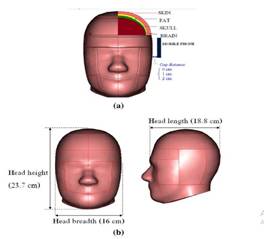
It is more practical to take the human head as a simple model to study in the form of four layers: Skin, Fat, Bone and Brain (figure 2), as well as their densities and electrical properties of these tissues for the two significant frequencies 0.9 GHz and 1.8 GHz, table: 1
[21].
19 A. L. Galeev, ''The effects of microwave radiation from mobile telephones on humans and animals'', Neuroscience and Behavioral Physiology, Vol 30, No. 2. 2000.
20 F. Brucciani, ''Champs électromagnétiques et santé'', Parlement
Européen, Note de synthèse n 05/2001.
21M. Martinez-Burdalo and al, “Comparison of FDTD calculated specific
absorption rate in adults and children when using a mobile phone at 900 and
1800 MHz”, Phys. Med. Biol. 49 (2004), pp. 345-354.

 Figure 2: Position du mobile par apport à
la tête humaine
Figure 2: Position du mobile par apport à
la tête humaine
11.1.Formulation of the problem of radiation of the human head by the mobile phone:
Figure 4 shows the radiation of electromagnetic energy from a mobile phone modeled on the human head. Due to ethical considerations, exposure of the human head to electromagnetic fields for experimental purposes is limited. It is more convenient to put realistic human head model through digital simulation. The following section, an analysis of specific absorption rates and heat transfer in layers of the human head exposed to cell phone radiation are illustrated.

Figure 4: The human head exposed to radiation from the mobile phone.
11.2. Model of the electromagnetic power received
by the brain. [23 ]
As a function of the penetration depth * z * on the one
hand and as a function of the frequency f of the incident wave on the other hand. The electromagnetic power curve can be modeled as follows:
 𝜎 2
𝜎 2
𝑃é����� = 2 |�|
(35)
Figure 3: The human head model, (a) section of the human head model, (b) the dimensions of the human head model.
Table 1: Electromagnetic characteristics of the human
paramètres Frequency in
GHz Skin Fat Bone Brain �� 0,9 43,74 5,46 12,45 52,73 1,8 41,36 5,35 11,78 50,08 ��[��−1 ] 0,9 0,855 0,051 0,143 0,942 1,8 1,21 0,078 0,275 1,391 �[��−1 °�−1 ] 0,9 0,528 0,195 0,528 0,5 1,8 0,528 0,195 0,528 0,5 �� [����−1 °�−1 ] all 3662 2400 1256 3650 ��� all 1 1 1 1 �[�𝑔�3] all 1100 920 1850 1050
head [22]
22 M. Martinez-Burdalo and al. Op.cit.
With: 𝑃é����� : Electromagnetic power received by
the brain in W
𝜎 : Electrical conductivity of the brain ��−1
� : The total electric field received by the brain in
V /m
11.3. Model of energy received by the brain from electromagnetic waves
We admit that the amount of energy received by the brain from electromagnetic waves is very high compared to that which emerges from it by radiation, and that almost all of the energy received is transformed into heat ( in the worst case). We can therefore write the following thermodynamic equation for conservation of energy :
�é����� = 𝑃é����� . 𝜏 (36)
23
RECOMMANDATION UIT-R BS.1698 : Evaluation des champs provenant des systèmes d'émission
de radiodiffusion par voie hertzienne de Terre fonctionnant dans n'importe quelle bande de fréquences pour estimer l'effet de l'exposition aux rayonnements non ionisants
�é����� = �. �. ∆𝜃 (37)
� : The mass and volume of a human brain
𝜏 : Irradiation time in hours
∆𝜃 : The temperature variation in the brain °C
C : Average specific heat capacity of the brain
From equations (36 and 37) we can deduce the temperature variation in the brain as follows:
The penetration depth is defined as the distance for the power density to be reduced to 13% of its initial value, the distance z = 1 / α is called the SAR penetration
depth [24] [25 ][26 ][27].
In order to protect people near radio antennas, standards
regulate the maximum values of radiofrequency electromagnetic fields to which people can be exposed. Many standards exist. European standards (directive
1999/5 / EC) define recommendations on the band 10
MHz – 300 GHz, based on a SAR < 0.08 W/kg for a
whole body[28].
 ∆𝜃 = ��é���𝑐����.𝜏
�.�
(38)
12. Case study (digital application)
The body's capacity to absorb energy is characterized by the following quantity Specific Absorption Rate
(SAR). This is the ratio of the amount of energy �� absorbed by an element of mass �� contained in an elementary volume ��. ���� is the effective value of
the absorbed electric field and ρ is the density of the
absorbent tissue.
We will use the previous theoretical analysis to evaluate the power distribution induced by an electromagnetic wave of 1.8GHz in a spherical brain model with radius 8 Cm.
12.1.Model adopted for the incident field
We admit the following expression for the incident field along the ox axis:

 ���� ( � ) = �𝑃
(41)
�𝑔 ��
�� = �� � −����� �� en V/m (48)
 We know that: 𝑃 = ��
��
Replace (42) in (41), we find:
(42)
𝑃� = 1��/��2 Power of the incident wave [29] [30 ]
𝜇

��𝑜

 ���� ( � ) = � (�� ) (43)
�� = √
𝑜
(49)
�𝑔
�� ��
�� = 120��� = 376,8𝛺
Gold, �� = �. �𝑣 (44)
By replacing the expression (44) in (43), we thus
obtain:

 ���� ( � ) = � ( ��
) (45)
���� ( � ) = � ( ��
) (45)
�� = 376,8𝛺 Power of the incident wave
𝜎 = 0,9 mS/m[31]
�� = 35
�� = 87 �/�[32]
�𝑔
�� �.��
Note: These quantities chosen by way of example
For: �� = 𝜎 �2 (46)
correspond to plausible average values of the

 �� 2
�� 2
���
electrical parameters for a given brain. Their exact
From where:
���� ( � ) = 𝜎 �2 (47)
determinations depend on the nature of the emitting source and the electrical properties of the biological system in question, which is not easy.

 �𝑔
�𝑔
2� ���
According to our theoretical study this problem leads


 Is: ���� ( � ) = 1 = 2√ ��0 √𝜀
(48)
us to solve the matrix system:
�𝑔 �
��0 𝜎
24 S. C. Hagnness, “Two-Dimensional FDTD Analysis of a Pulsed
Microwave
Confocal System for Breast Cancer
Detection: Fixed-Focus and Antenna-Array Sensors”, IEEE Trans. Biomedical engineering, vol. 45, no. 12, Decembre 1998, pp. 1470-1479
25 J. D. Kraus, K. R. Carver, “Electromagnetics”, New York, McGraw-Hill 1973, pp.
445-465.
26 A. K. Lee and al, ''Study on dielectric properties of phantom material for
SAR test in human body'', Progress In Electromagnetics Research Symposium
2006 - Tokyo, Japan, August, 2-5.
27 T. Wessapan and al, ''Specific absorption rate and temperature distributions in human head subjected to mobile phone radiation at different frequencies'', Elsevier, International Journal of Heat and Mass Transfer
28 [ANFR].
29 Matthew N. O. SADIKU, « Numerical techniques in electromagnetics », Ed. Boca Raton, CRC press, New York, Washington DC. (2001) P 338-356.
30 Si les antennes relais n’ont pas de limites de puissance (les normes définissent le champ électrique maximum sur les lieux de vie), les téléphones
mobiles voient leur puissance limitée selon le type : 2W en GSM 900, 1W en
GSM 1800 et 0,125W en UMTS 2100. Le Wifi est limité à 0,1W.
31 M. Martinez-Burdalo and al. Op.cit.
32 Matthew N. O. SADIKU, Op.cit.
 [�][�] = −[�� ]
By inversion of the matrix G we obtain the solution:
[�] = −[�]−1 [�� ]
Our brain is centered at the origin of our reference point
(x, y, z), we will fill our biological system, that is to say the brain in question with small cubes having an edge a = 1 cm.
For reasons of symmetry we consider the upper right quarter of our biological system, that is to say x and y positive. There are 35 in total. The coefficients of the matrices G and E are evaluated using computer processing (in Matlab).
12.2. Simulation results and interpretation
12.2.1. Electromagnetic power as a function of the depth crossed

Figure 6: Electromagnetic power as a function of the depth crossed
By virtue of Figure 6 above, we find that the electromagnetic power received by the brain as a function of the depth traversed is a sawtooth function. This power is most concentrated at the end of the brain closer to the area of the head where the telephone handset is stuck. It is this end that heats up the most.
This is comparable to a pan over a fire, in fact the area of the pan exposed to the fire that will heat up the most.
Just as a microwave heats food, so the brain will heat up when it is irradiated with electromagnetic waves. Thermal effects are due to the heat dissipation of radiation energy reaching the tissues. The water molecules present in biological tissues will begin to oscillate at the frequency of the incident wave, thus creating internal friction responsible for heating the irradiated tissues. This heating will be all the more important as the tissues are rich in water. However,
electromagnetic waves can also cause non-thermal effects.
12.2. 2. Power as a function of incident radiation frequencies
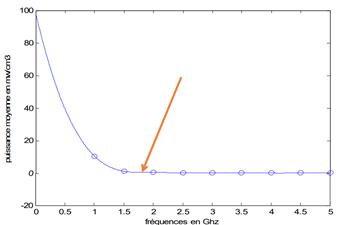
La valeur moyenne 𝑃��� = 0 ,7 �� / �� 3
Figure 7: Average power as a function of the frequency of incident radiation
This Figure 7 giving the electromagnetic power in the brain as a function of different frequencies of incident radiation shows for radiations of the same power, but of different frequencies the brain heating is not the same. The heating of the brain or the biological system decreases as the frequency of the waves radiating it increases. Thus at low frequencies, that is to say less than a few tens of megahertz, it is the biological effects of a thermal nature that are preponderant, while at high frequencies the thermal effects are not very significant. However, the use of high frequencies, of the order of tens of gigahertz and more, can cause non-thermal effects harmful to health. An illustrative example of what we have just said is the X-ray beam. Indeed, an X- ray beam has several harmonics: the low frequencies which cause burns in irradiated patients, they are undesirable. It is their high frequencies, also called hard X-rays, that are used for the destruction of cancer cells. Thus, when irradiating a patient, care is taken to place a lead barrier between the latter and the X-ray source to attenuate soft X-rays (low frequencies) and only allow hard X-rays to pass.
12.3. Assessment of the rise in temperature of a brain
According to the study using a cell phone can cause a 2 to 3 °C increase in brain temperature. To do this, in we will demonstrate it by simulation.
Consider our previous spherical model of a brain irradiated by an electromagnetic wave of 1.8 Ghz.
Figure 7 shows that, the mean 𝑃��� = 0,7��/��3 of
power inside the brain.
Considering the model (38) of temperature variation, the mass and volume of a human brain are estimated on average to be 1.3 kg and 1.5 liters respectively. Which
corresponds to an average density: � = 870 �𝑔 / �.
In addition, biological systems in general and the brain
in particular are made up of 70% water, and it is mainly these molecules that are subjected to internal friction responsible for heat. It is therefore logical to take as the average specific heat capacity of the brain a value close to that of water, namely:
� = 4000 �. ���−1 � −1
We can thus assess the different temperature rises in the brain
depending on the duration of the telephone call. For a period of
6 hours, we obtain the curve below giving the temperature rise in degrees Celsius and a function of the duration of irradiation of the brain in hours.

Figure 8: Rise in brain temperature as a function of the duration of irradiation of the brain in hours
The curve in Figure 8 shows that brain warming is a linear function of the duration of communication.
13. Health effects and precautions to be taken
13.1. Some possible health effects
Note that any stimulation of a cell, tissue or organism, whether by electromagnetic waves or by any other exciter of a given nature can be accompanied by a normal adaptive response of the latter: c is a biological effect. However, a biological effect can endanger the
normal functioning of an organism when its physiological response capacities in response to the action of the external agent are exceeded: a so-called health effect occurs and health is impaired not.
Thus frequent, usually prolonged exposure to radiofrequency waves can cause some health effects in the short, medium or long term such as:
 Headaches
Insomnia
The modification
of
the electroencephalogram with significant consequences on memory, reduction of reaction time.
Alzheimer's and Parkinson's diseases:
In
fact
nerve cells are not subject to cell division, the most likely consequences of damage to their DNA are functional changes and cell death, which is a promoter or co-promoter of these neurodegenerative diseases.
Disruption of the pineal gland or epiphysis can
induce long-term cancer.
Alteration
in cell flow
due
to temperature
increases or electromagnetic forces induced by external fields on cell walls. It can lead to medium or long term functional changes and even cell degeneration.
Possible cases of arterial hypertension: Indeed the
blood pressure in the blood vessels can according to the laws of fluid mechanics be modified if the blood fluid molecules (ionic) are subjected to additional forces, induced for example by external electromagnetic waves. But this effect can only be significant in the long term.
Many other possible health effects can be identified. This will require continuing experimental and epidemiological studies on various groups of populations, taking into account the duration of their exposure, the frequency and intensity of "aggressive" waves.
13.2. Some precautions to take
To prevent the biological or health effects of radiofrequency waves, we can take some measures, namely:
 The use of the "hands-free kit" It allows you to
make
calls without having
to stick the phone to your ear, which reduces the power absorbed under the effect of distance.
The use of the "hands-free kit" It allows you to
make
calls without having
to stick the phone to your ear, which reduces the power absorbed under the effect of distance.
It is necessary to use it for long-term communications. Le « stop-onde » It is a plate that sticks behind the cell phone as close to the antenna.
Its physical principle is that it shifts the wave it receives by 180 °. This creates destructive interference, which attenuates the stray waves. But there is no loss in reception or transmission quality.
Absorbent pads: They are glued
to the housing of the mobile and reduce the power dissipated in the user's head by attenuation. But the main drawback here is that the effectiveness of the radiation from
the
mobile is reduced.
Avoid calling while traveling [33].
The phone transforms the voice into radio frequency waves that propagate through the phone's antenna to a base station relay antenna. When the user moves, several base stations take over in succession, each starting its communication at a high power level before gradually lowering it until it stabilizes at a minimum level compatible with good communication quality.
ü Avoid communication in places with poor reception [34].
Conversation in a place with poor reception forces the relay antenna and the mobile phone to remain at high power levels. The greater the power, the poorer the quality of communication.
14. State of progress of science and research:
Some research carried out suggests the existence of a correlation between exposure to the electromagnetic field and human health, and more particularly with regard to leukemia in children [35], and leukemia and brain cancer among workers in the electrical trades [36].Other more recent research provides conflicting results, and fails to draw a conclusion about the association between the electromagnetic field and these diseases. Research on the intensity of electromagnetic waves from which they can be harmful to health is legion. The current limit values are based elsewhere on the proven results of these studies.
The main objective of current research is to find out whether mobile telecommunications can have other consequences. Scientists have been wondering for about ten years now whether, in the frequency range of mobile telecommunications, athermic effects, i.e. not based on heating, could cause, in certain circumstances, sleep disturbances, difficulty concentrating, headaches, and even other physiological disorders.
33 « Les
antennes relais
de
la téléphonie mobile et les inquiétudes
pour la santé publique » Journal officiel des
communautés européennes. L 1999/59, 30 juillet 1999.
34 « Les antennes relais de la téléphonie mobile et les inquiétudes pour la santé publique » Journal officiel des communautés européennes. L 1999/59, 30 juillet 1999. Op.cit.
But scientific studies in this area are very complex. We must not only eliminate all other influencing factors, which is proving particularly difficult, but also ensure that the results obtained are reproducible. However, the researchers were not discouraged and, to date, the thousands of in-depth studies carried out across the globe have almost all reached the same conclusion: within the limits of legal values. In force, mobile telecommunications have no harmful effects on health which can be scientifically demonstrated. In other words: mobile telecommunications technology can be used without fear of harmful effects on health.
Conclusion
The results obtained in this work allowed us to observe the influence of the factors frequency, intensity and duration of exposure to waves irradiating a given biological system. Our study can be applied to any biological system other than the brain, the shape of the curves that we would obtain in this case will be identical to those obtained for the brain. However, establishing a link between health effects and electromagnetic waves is not easy. The main difficulty lies in accurately measuring the exposure of each person, as several parameters such as the diversity of phones, modes of use, geographic areas and frequency of use depend on it. But the results obtained can be used and can strengthen the validity of the results of epidemiological and experimental studies. These will need to be reinforced by multiple tests on various populations regularly subjected to various radiation and for periods ranging from zero to human life expectancy. Each individual is required to adopt preventive attitudes at their own level as mentioned above.
BIBLIOGRAPHY:
ü ANFR.
ü C. Sage, D. O. Carpenter “Public health implications of wireless technologies”, Pathophysiology (2009), Elsevier, January 2009, N°. of pages 14.
ü De RIDDER et VANHOORNE « Exposition aux champs magnétiques 50Hz et cancer: Un aperçu de la littérature récente, », Archives of public Health, Vol. 53, n°1-4 (1995) 35-52.
ü Electrosmog-info, ''Téléphones Mobiles et Champs
Electromagnétiques'', V1, novembre 2010.
ü En route pour Mars , Science & vie, no 949 Octobre
(1996) P 106.
35 N. Wertheimer, E. Leeper, ''Electrical wiring configurations and childhood cancer'', American Journal of Epidemiology 109, 273 - 284.
36 G. Goldberg, M. Miller, ''Occupational exposure to magnetic fields among electric utility workers in ontario and Quebec, Canada,
and France'', 1970-1989. American Journal of Epidemiology, Vol
139, No 6, P 550 - 572, 15 mar 1994.
ü F. Brucciani, ''Champs électromagnétiques et santé'', Parlement Européen, Note de synthèse n 05/2001.
ü J. D. Kraus, K. R. Carver, “Electromagnetics”, New York,
McGraw-Hill 1973, pp. 445-465.
ü Joseph Antoine BASSESUKA SANDOKA NZAO : Notes des cours des applications de l’énergie électriques, destinées aux étudiants finalistes du département d’électricité premier cycle de l’ISTA/KINSHASA RD Congo
ü K. Lee and al, ''Study on dielectric properties of phantom material for SAR test in human body'', Progress In Electromagnetics Research Symposium 2006 - Tokyo, Japan, August, 2-5.
ü L. Galeev, ''The effects of microwave radiation from mobile telephones on humans and animals'', Neuroscience and Behavioral Physiology, Vol 30, No. 2. 2000.
ü L. Hardell, C. Sage, “Biological effects from electromagnetic field exposure and public exposure standards”, Biomedicine & Pharmacotherapy 62 (2008), Elsevier Masson 31 December 2007, pp. 104 - 109.
ü M. Martinez-Burdalo and al, “Comparison of FDTD calculated specific absorption rate in adults and children when using a mobile phone at 900 and 1800 MHz”, Phys. Med. Biol. 49 (2004), pp. 345-354.
ü M. Plante, ''Cellulaires et santé'', l’électromagnétisme et la santé, le Médecin du Québec, volume 45, numéro 4, avril 2010.
ü Matthew N. O. SADIKU, « Numerical techniques in electromagnetics », Ed. Boca Raton, CRC press, New York, Washington DC. (2001) P 338-356.
ü MOUMEN CHERIF : Effets des radiations électromagnétiques sur le corps humain, Thèse Présentée en vue de l’obtention du Diplôme de Doctorat en Sciences en Electronique Option : Composants Electroniques Université de Constantine 1 Page 1
ü N. Pellieux, ''Champs électromagnétiques'', INRS, 1er éditions mars 2008.
ü OM P. GANDHI « State of Knowledge for electromagnetic absorbed dose in man and animals », Proceeding of IEEE, Vol. 68, N°1, January (1980).
ü P. Demaret, '' Effets biologiques des rayonnements électromagnétiques'', INRS, 7eme Conférence Internationale, Malte, 8-12 octobre 2012.
ü P. Demaret, '' Effets biologiques des rayonnements électromagnétiques'', INRS, 7e Conférence Internationale, Malte, 8-12 octobre 2012.
ü Ph. Piolé, ''Comment caractériser une antenne'', Fiche savoir 0123, 30 juillet 2004.
ü R. Vignal and al, ''Effects of mobile phones and radar radiofrequencies on the eye'', Elsevier Masson, Pathologie Biologie 57 (2009) 503-508.
ü RECOMMANDATION UIT-R BS.1698 : Evaluation des champs provenant des systèmes d'émission de radiodiffusion par voie hertzienne de Terre fonctionnant dans n'importe quelle bande de fréquences pour estimer l'effet de l'exposition aux rayonnements non ionisants
ü S. C. Hagnness, “Two-Dimensional FDTD Analysis of a Pulsed Microwave Confocal System for Breast Cancer Detection: Fixed-Focus and Antenna-Array Sensors”, IEEE Trans. Biomedical engineering, vol. 45, no. 12, Decembre 1998, pp. 1470-1479
ü T. B. Carlos KONLACK* et Roger TCHUIDJAN : Analyse de l’impact des ondes électromagnétiques sur l’homme, Département des Génies Électrique et des Télécommunications, ENSP B.P. 8390, Université de Yaoundé I, Cameroun
ü T. Wessapan and al, ''Specific absorption rate and temperature distributions in human head subjected to mobile phone radiation at different frequencies'', Elsevier, International Journal of Heat and Mass Transfer
ü V. I. T. Ahmed and al, “Effect of mobile phone radiation on heart rate variability”, Computers in Biology and Medicine 38 (2008), Elsevier, March 2008, pp. 709-712.