Vitrine de la RDC
MODELING AND EVALUATION OF THE EFFECTS OF ELECTROMAGNETIC COMPATIBILITY IN TELECOMMUNICATIONS
Samuel Garcia TUKA Biaba Genie Electrique/Electrotechnique ISTA Kinshasa et ISTA Kindu Kinshasa, RD Congo tukasamuel23@gmail.com
Abstract - In the field of communications, mobile telephony has constituted a new axis of study, because it has for the first time caused the exposure of populations to ultra-high frequency electromagnetic fields emitted by nearby sources (telephone antenna, relay antenna or BTS, ...). The possible effects of the electromagnetic waves used are of concern to researchers and faced with the abundance of these strange radiations coming from our means of communication, a question arises concerning their effects on human health and in particular on biological tissuesas well as the potential risks for people exposed to interactions between electromagnetic fields and the human body which are real and therefore require protective measures.
Mathematical and numerical analysis using Maxwell's equations and computer tools such as Matlab and Excel, will allow us to model and simulate the total electric field radiated by the mobile phone, in order to characterize the distribution of electromagnetic power in the system organic. This approach will allow us to draw a conclusion on the modeling of electromagnetic compatibility in communication and impact on health.
Keywords: EMC, communications, mobile telephone, wave electromagnetic, induced current, biological system.
I. INTRODUCTION
The interaction of electromagnetic fields with biological tissues has been the subject of many years of research motivated by the public health problems posed by the sharp increase in recent decades of sources of exposure to electromagnetic fields. Recently individual communication by GSM phones (Global System for Mobiles) has become widely used in the public [19]. This development has resulted in an increase in the number of people exposed to the intense electromagnetic field, the average exposure time, and the amount of radiation absorbed [1].
The existence of a low health risk at the individual level could then result in significant consequences for the population.
Indeed, the galvanic coupling corresponds to the case of a physical contact between the electromagnetic field source (cell phones) with the biological medium (human head) causes the flow of a ohmic current in the brain. The consequences may result depending on the intensity and frequency of contact current tissue heating see a burn.
Many fears are now expressed about the harmful health of the radiofrequency fields emitted by mobile phones. Since the head and the skin are the most exposed organs, the cerebral blood circulation, the skin microcirculation in the face and the electrical activity of the brain are specifically concerned [14] [20].
To carry out this study and quantify the consequences on biological tissues exposed to electromagnetic fields,
we proceeded by solving Maxwell's equations and by using computer tools such as Matlab and Excel in order to model and evaluate the field total electric power, this allows us to quantify: the electromagnetic power received by the brain during communication, the wavelength in the muscles, the depth of penetration of the electromagnetic field in the brain, the skin effect, the variation of the brain temperature and propose mitigating measures to prevent the biological or health effects of these radiofrequency waves.
II. DEVELOPMENT
A. Coupling Mechanisms Between the Electromagneic
Field and the Biological Tissue [16]
In the case of biological media, the phenomena of energy absorption in tissues can be relatively complex and depend on many factors. They are related primarily to the coupling between the emission source and the biological environment.
Galvanic coupling corresponds to the case of physical contact between the source and the medium. This contact causes the flow of an ohmic current in the body of the person and the consequences may result depending on the intensity and frequency of contact current tissue heating, see a burn. Radiated coupling includes three fundamental mechanisms by which electric and / or magnetic fields, of variable frequency over time, interact with biological media including :
- Coupling with low frequency electric fields:
- Coupling with low frequency magnetic fields:
- Energy absorption from electromagnetic fields :
The human exposure to electric or magnetic fields generally low frequency causes a significant energy absorption and no measurable temperature rise.
Against by, exposure to electromagnetic fields at frequencies above 100 kHz can cause absorption of energy and a significant rise in temperature.
In general, exposure to electromagnetic fields results in a highly inhomogeneous deposition and distribution of energy within the body which must be assessed by dosimetry. Finally, it remains to highlight the indirect effects caused by exposure to electromagnetic fields for people carrying active medical implants (pacemaker, defibrillator, insulin pump ...) that result in malfunctioning of the implanted material.
B. Theoretical Approach to Wave-tissue Interactions
Mathematical modeling of the interaction of electromagnetic fields requires knowledge of the properties of the radiation source, the geometry of the exposed body as well as its electrical properties (conductivity, permittivity and permeability).
The importance of these interactions depend on:
- Intensity
- Frequency
- The orientation of the electromagnetic field to which the tissue is exposed
- The geometry of the fabric and its electromagnetic characteristics:
* magnetic permeability (μ)
* dielectric permittivity (ε)
* conductivity (σ)
- The coupling between the field and the body, that is to say: tissues, organs ...
The latter is equal to that of the vacuum for biological tissues because these are considered to be non-magnetic. Electrical conductivity and magnetic permeability are specific to each tissue and depend on many factors such as frequency and temperature.
The behavior of the electromagnetic field produced by an external source and propagating towards a biological medium is described by Maxwell's equations using simple geometric configurations [23]. In this article, we consider an interaction of a plane wave with a homogeneous and isotropic linear medium.
- A medium is linear if the response to a linear combination of excitations is itself a linear combination of the responses obtained for each of the excitations.
- A medium is isotropic if its structure is equivalent in all directions.
- A medium is homogeneous if its properties do not vary from one point to another.
Several interactions can take place with frequent exposure to an electromagnetic field. This leads to short-term effects, direct (biological responses) or indirect.
According to the WHO, the current state of scientific knowledge does not demonstrate the long-term danger of exposure to low-intensity electromagnetic fields.
To further this research, we will highlight the following physical laws in order to explain the actions and effects of electromagnetic waves on the human body [10]:
Maxwell-Faraday: Ñ * E = -¶B/¶t (1) Maxwell-Ampère: Ñ * H = j+¶D/¶t (2) Maxwell-Gauss : Ñ * D = r (3)
La loi d’Ohm : j= sE (4)
B=m0H (5)
D=e0E (6)
The coupling that appears in equations (1 and 2) helps to explain the phenomena of propagation and radiation.
C. Propagation of an electromagnetic wave in biological tissues
Biological media lie between dielectrics (insulators) and perfect conductors. Suppose that the charges are uniformly distributed in the environment, then we can write:
Ñ(r/e) = (1/e) *Ñ(r/e) (7)
Because ρ is independent of the observation point M.
We know that ÑE = r/e (8) In this case, from equation (3), we write:
Ñ(r/e) = Ñ(ÑE ) (9) From equation (1 and 2), we can write:
Ñ´(Ñ´E ) = -ms(¶E/¶t) -ms(¶2E/¶t2) (10)
For an electromagnetic field which is sinusoidally dependent on time, and considering the equations presented above (see equations: (1), (2), (3), (4), (5) and (6)), for the vector field like the electric field E, each of the components in a homogeneous and isotropic linear medium (LHI) assumed to be infinite, can be written in the following compact form [9]:
E =Re [(e) Exp (-j (vt))] (11)
By analyzing this writing, the real field is written:
E = E0*Cos (vt-j0) (12)
Considering the attenuation and phase shift per unit length respectivel [8]:
a = wÖ[(m0/2)*a/w] (13) For : 0 £ a £ 1
b = wÖ[(m0/2)Ö[2+ (a/ew) 2]] (14)
The expression of the field E which propagates along the z axis is written:
E = E0*[ Exp (-a*z)]Cos (vt-bz-j0) (15)
Pz = (b/2m0w) E2 *[ Exp (-2a*z)]Cos (vt-bz-j0) (22) If j0 is zero, the mean power transported becomes :
0 0
Pz = (b/2m0w) E2 *[ Exp (-2a*z)]Cos (vt-bz) (23)
For frequencies of the order of 1 GHz, ωt> βz, the average power transported becomes :
0
Pz = (b/2m0w) E2 x*[ Exp (-2a*z)]Cos (vt) (24) The absorbed power density D in Watt per cubic meter
[(W/m3] in the medium and transformed into heat is given by:
0x
The penetration of electromagnetic fields in the tissue
D=-dPz/dz = (r/2)* E2
*[ Exp (-2a*z)] (25)
will be very quickly limited because of a part of the skin effect and partly because of the dissipation of energy in the middle. To understand these phenomena, we considered analytically the equation (13) which explains the spread of the electric field in the vacuum and the equation (15) models propagation of the electric field in the biological environment. The skin effect results in a decrease of the field E (z) at a distance *z* from the interface according to the relationship:
Equation (25) shows that the energy absorbed is a
function of the conductivity of the medium and decreases in the direction of propagation. By introducing the density, we can also obtain from equation (25), the specific absorption rate (SAR) which is expressed in Watt per
kilogram [W / kg] as follows :
0x
SAR = D/r = (s/2r)* çE2 ç (26)
E. The electromagnetic wavelength in the muscle
E = E0*[ Exp (-a*z)] (16)
Where E0 is the field strength at the interface.
D. Electromagnetic power received by the brain[15]
For a wave which propagates in the brain along the z axis and whose electric field E is polarized in the x direction and the magnetic field vector H is polarized in the y direction, the expression of the fields E and H is written as follows:
The wavelength (λ) corresponds to the length of a complete cycle of a wave. This length corresponds to the distance between two identical points of the wave at a given moment, that is to say two points located at the same amplitude. In the case of a transverse wave, the length of a complete cycle corresponds to the distance between two peaks of the wave or two troughs.
l=c/f (27)
c = wave speed in meter per second [m/s] (=3.108 m/s)
Ex = E0x*[ Exp (-a*z)]* Exp (-j (vt-bz) (17)
Hy = H0y*[ Exp (-a*z)]* Exp[ j (vt-bz+j)] (19) Where E0 and H0 represent the amplitude of the field at
the origin z = 0 and φ represents the phase difference
between the E and H fields given by:
tan(j)=a/b (20)
The average power carried per unit area for a monochromatic plane wave moving in the direction of propagation is given by the following relation:
<P>=1/2*(E´H) (21)
In the case of the Ex / Hy wave, the vector P has only one component along the z axis, namely:
λ= wavelength in meters [m]
f = frequency in Hertz
F. Energy received by the brain from electromagnetic waves
This energy can be defined from the thermodynamic equation of energy conservation:
0x
Ez= (s/2)* çE2 ç*t (28)
Ez=r*Cp*Dq (29)
r: The mass and volume of a human brain in 870 kilogram per cubic meter [kg/m3]
t: irradiation time in hours [h]
Dq: the temperature variation in the brain in degree celsius
[°C]
Cp: Average specific heat capacity of the brain in Joule per kilogram celsius [J/kg °C]
From equations (28 and 29) we can deduce the variation in brain temperature as follows:
The fact that biological systems are very complex and made up of several types of tissues with different electromagnetic characteristics (permittivity and conductivity), made these models very complex to produce. The model must be representative of a user's head and allow an analysis of the power absorbed in the different tissues. Digital models are usually built from magnetic resonance images (IRM) (Simunic et al., 1996).
Numerical simulations are generally carried out by the
FDTD (Finite Difference Time Domain) method (Yee,
1966) which consists in solving Maxwell's equations in the
0x
Dq = (s/2r)* çE2
ç*t/rCp
(30)
temporal and spatial domain. A mobile phone operating at
900 Mega Hertz [MHz] and with a powerful peak of 2 Watts
0x
With : (s/2r)* çE2
ç= P
moy
average power received by the
[W], the simulations indicate a SAR of 1,1 Watt per
brain in millewatt per cubic meter [mW/ Cm3]
We will below, proceed to the numerical simulation of various electromagnetic quantities modeled above.
III. SIMULATION AND INTERPRETATION OF RESULTS
A. Assumptions and necessary data
1) Hypothesis [2]
We will use the previous theoretical analysis to evaluate the power distribution induced by a 1.8 Giga Hertz
[GHz]electromagnetic wave (GPS) in a spherical brain model with a radius of 10 Centimeter [Cm].
2) Data needed
Pi =1 mW/ Cm3:Incident wave power [13];
Z0 =120p Ohm [W] : Intrinsic vacuum impedance [3];
er=35 and s= 0,7 in mileseconds per meter [ms/m][13];
e0=10-9/36p Faraday per meter [F/m] and e0=4p10-7 in
Tesla per Ampere meter [T/Am];
a = 0,1 and b = 4 in radian per meter [rad/m] [4];
The mass and volume of a human brain are estimated on average to be 1,3 kilogram [kg] and 1,5 liters respectively. Which corresponds to an average density [4]:
r=870 kilogram per cubic meter [kg/m3]
It can be said that the biological system and the brain are generally made up of 70% water, and it is these molecules that are mainly subjected to internal friction responsible for heat. It is therefore logical to take the average specific heat capacity of the brain a value close to that of water, namely:
Cp=4000 Joule per kilogram celsius [J/kg °C] [5].
3) Modeling of biological tissues [14]
kilogram[W / kg]. Dosimetric analysis also shows that the
head absorbs about 50% of the power emitted by the radio
telephone, the skin absorbing 15%, the muscle 10%, the cerebrospinal fluid 5% and the brain 13%.
B. Presentation and analysis of simulation results
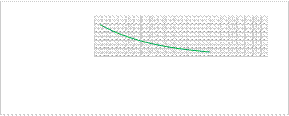 1) Electric fields in the tissues as a function of the depth
to be crossed
1) Electric fields in the tissues as a function of the depth
to be crossed
 100
100
50
0
0 10 20 30
Crossing depth z in centimeter[Cm]
Fig.1. Curve of electromagnetic fields in tissues as a function of the depth crossed
We find that the penetration of electromagnetic fields into the tissues will be very quickly limited because of the skin effect on the one hand and the energy dissipation in the medium on the other hand. The skin effect results in a decrease in the electric field at a distance z from the interface.
 2) Wavelength variations in the muscle as a function of
the
Frequency
2) Wavelength variations in the muscle as a function of
the
Frequency
![Zone de Texte: Wavelength in
in centimetr
[Cm]](publication%20Softcom%202021%20fine2_fichiers/image004.gif) 4
4
2
0
0 5 10 15
frequency in Giga Hertz [GHz]
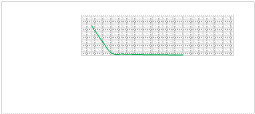
Fig. 2.Variation of wavelength in muscle as a function of frequency.
The curve in Figure 2 above shows the variations in muscle wavelength as a function of frequency. It shows that at a frequency of 2 Giga Hertz [GHz], the length of the wave propagating in the muscle is 1,5 centimeter [Cm]. The electrical parameters used to construct this figure (as well as the following ones) are taken from [6].
 3) Penetration depth of the electromagnetic field
 200
200
100
0
0 0,5 1
Attenuation in centimeter exposing minus oneCm-1
Fig. 3. Variations in depth of penetration δ as a function of linear muscle
weakening factor
Figure 3, plotted from equation (28) shows that the skin effect is not preponderant at low frequencies and that the depth of penetration of the electromagnetic field decreases with frequency. For muscle, it is of the order of 100 centimeter [Cm] at 0,01 centimeter exposing minus one
[Cm-1] of weakening. It decreases to values below 1 millimeter [mm] for higher frequencies. The higher the
frequency of the signal, the more the internal organs are
protected from the effects of radiation by the outer layers of the human body.
 4) Power as a function of the depth crossed

 2
2
1
0
0 10 20 30
-1
Crossing depth z in Centimeter [Cm]
Fig. 4. Electromagnetic power received by the brain as a function of the depth crossed z in Centimeter [Cm]
The curve in Figure 4 shows that the power received by the brain is more concentrated the closest to the area of the head where the telephone handset is stuck. It is this end that heats the most in the same way that a microwave plate heats food. The brain will be heated when it is irradiated by electromagnetic waves. This heating will be all the more important as the tissues will be rich in water.
 5) Electromagnetic power as a
function of frequencies
5) Electromagnetic power as a
function of frequencies
![Zone de Texte: Power in millivolt
per cubic centimeter
[mW/Cm3]](publication%20Softcom%202021%20fine2_fichiers/image011.gif) 200
200
0
0 2 4 6
-200
Fréquency in Ghz
Fig. 5. Electromagnetic power received by the brain as a function of wave frequencies
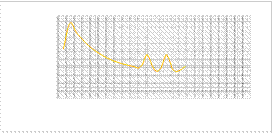
Figure 5 shows that the heating of the brain or the biological system decreases as the frequency of the waves radiating it increases. Thus at low frequencies, that is to say
less than a few tens of megahertz, it is the biological effects of a thermal nature that are predominant, while at high frequencies the thermal effects are not very significant.
However, the use of high frequencies, of the order of tens of gigahertz and more, can cause non-thermal effects which are harmful to health.
6) Brain heating depending on the duration of irradiation
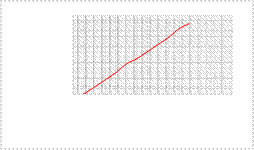 Consider our previous model of brain irradiated with an electromagnetic wave of 1.8 GHz, the average value of the power of 0,52 millivolt per cubic centimeter mV/cm3 within the brain obtained by numerical simulation (see Figure 5 below above). To get the curve of the change in brain temperature, we will implement equation (27).
![Zone de Texte: Elevation of brain
temperature in degree celsius [° C]](publication%20Softcom%202021%20fine2_fichiers/image013.gif) 6
6
4
2
0
0 5 10 15
Irradiation period in hours[h]
Fig. 6. Variation in brain temperature
We find that the mean brain temperature as a function of the duration of irradiation is a linear function of the duration of communication and will continue to increase with it.
IV. SERIOUS EFFECTS OF RADIOFREQUENCIES ON HEALTH [11]
In 2008, the “International Appeal of the 20 against the cell phone” was launched, at the initiative of Dr David Servan-Schreiber. The 19 signatory scientists (Prof. Henri Pujol, president of the League against cancer, Dr. Annie J. Sasco, cancer epidemiologist who worked for the WHO, Prof. Devra Davis, Dr. Jean-Loup-Mouysset who will develop the center “ Resource ”, etc.) list 10 tips to follow, in particular to protect the health of the youngest in the face of mobile phone waves. It deals in particular with the particular fragility of the brains of the youngest, and the need not to allow children under 12 to use a cell phone, except in an emergency. In 2010, the results of the Interphone study were published. This study covers 13 countries around the world, and examines 4 types of tumors in the tissues that absorb the most radiofrequency energy emitted by mobile phones: tumors of the brain (gliomas and meningiomas), of the acoustic nerve (schwannoma) and the parotid gland. It does not cover cell phone use among young people.
V. PRECAUTIONS
To prevent the biological or health effects of radiofrequency waves, we can take some measures, namely [12] [18] :
- The use of the "Hands-free kit"
- The "stop-onde"
- Absorbent pads:
- Avoid calling while traveling.
VI. CONCLUSION
The analyzes and research carried out in this article demonstrate that the frequency, intensity of the electromagnetic field and the duration of exposure to electromagnetic waves significantly influence the behavior of the biological system. Thus, to arrive at a concrete result in our research, we have highlighted the different physical laws in order to explain the actions and effects of the electromagnetic waves radiated by the cell phone that we use during communication on the human body. This is demonstrated analytically in the various simulations carried out. We must note that the numerical simulations are generally carried out by the FDTD method (Finite Difference Time Domain) (Yee, 1966) which consists in solving Maxwell's equations in the space-time domain.
After simulation, the curves obtained indicate the following:
The penetration of electromagnetic fields into the tissues will be very quickly limited due on the one hand to the skin effect and on the other hand due to the dissipation of energy in the medium. The skin effect results in a decrease in the electric field at a distance z from the interface. The variations of the wavelength in the muscle are decreasing with the frequency. The power received by the brain is most concentrated at the end of it, closest to the area of the head where it is stuck. It is this end that heats up the most. The heating of the brain or the biological system decreases as the frequency of the waves radiating it increases. Thus at low frequency, that is to say at a frequency less than ten megahertz, the biological effects of a thermal nature are more preponderant, while at high frequency, the thermal effects are not significant, the heating Cerebral mean as a function of the duration of irradiation is a linear function of the duration of the communication and will continue to increase with the duration of the latter.
The results obtained can be used and can strengthen the validity of the results of epidemiological and experimental studies. These should be reinforced by multiple tests on various populations regularly subjected to various radiation and for periods ranging from zero to human life expectancy. Each individual is required to adopt preventive attitudes as mentioned above at their own level.
VII. BIBLIOGRAPHY
[1] Berg-Beckhoff, G., Blettner, M., & Kowall, B. (2009). Mobile phone base stations and symptoms: II - part of the exposure. [Antennes relais et symptômes: II - La part de l'exposition] Environnement, Risques Et Sante,
8(4), 291-292. (In English).
[2] Behari, J. (2010). Biological responses of mobile phone frequency exposure. Indian Journal of Experimental Biology, 48(10), 959-981. (In English).
[3] Carl H. DURNEY « Electromagnetic dosimetry for models of humans and animals: A review of theoretical and numerical techniques », Proceeding of IEEE, Vol. 68, N°1, January (1980). (In English).
[4] Carlos KONLACK et Roger TCHUIDJAN 1 : Analysis of the impact of electromagnetic waves on humans T. B Department of Electrical and Telecommunications Engineering, ENSP B.P. 8390, University of Yaoundé I, Cameroon. Africa SCIENCE 07(3) (2011) 1 - 14 ISSN 1813-548X, http://www.afriquescience.info T. B. (in French).
[5] On the way to Mars, "Science & Life, No. 949 October (1996) P 106 (in
French).
[6] Gabriel, C., Sheppard R.J., Grant, E.H., “Dielectric properties of ocular tissues at 37 degC”, Physics in Medicine and Biology, Vol.28, pp.43-49,
1983. Et Gabriel C., Gabriel S., "Compilation of the Dielectric Properties of
Body Tissues at RF and microwave Frequencies", hhtp://www.brooks.af.mil/AFRL/HED/hedr/reports/dielectric/. (In English).
[7] Jean-Paul ANDRETZKO : Contribution to the optimization and the modeling of an EMC measurement bench - Application to the characterization of the immunity of cardiac pacemakers, Thesis presented with a view to obtaining the title of Doctor of the University Henri Poincaré, Nancy- I in Instrumentation and Micro-Electronics, publicly defended on October 8, 2007. (In French).
[8] Jean-Paul ANDRETZKO: Contribution to the optimization and the modeling of an EMC measurement bench - Application to the characterization of the immunity of cardiac pacemakers: Thesis presented with a view to obtaining the title of Doctor of the University Henri Poincaré, Nancy-I in Instrumentation and Micro-Electronics. (In French).
[9] J-M Courty UPMC-L3-Physique –PGA: course notes version 0.2. (In
French).
[10] J.A.BASSESUKA SANDOKA NZAO: Notes from the courses of electrical energy applications, intended for finalist students of the electricity department, undergraduate of ISTA / KINSHASA RD Congo. (In French).
[11] Electromagnetic compatibility laboratory (tests department), high frequency metrology laboratory (Scientific and Industrial Metrology Department) File n ° m010492: estimate of the health impact of the main sources of electromagnetic fields in a residential environment: page 65. (In French).
[12] Mobile telephony relay antennas and public health concerns »Official
Journal of the European Communities. L 1999/59, July 30, 1999. (In French).
[13] Matthew N. O. SADIKU, « Numerical techniques in electromagnetics
», Ed. Boca Raton, CRC press, New York, Washington DC. (2001) P 338-
356. (In English).
[14] Rania GHOSN : Effects of mobile phones on human physiology: cerebral vascularization, cutaneous microcirculation, skin heating and electroencephalogram: Doctoral thesis Specialty Toxicology, to obtain the degree of Doctor of the University of Picardy Jules Verne in 2013 pp6. (In French).